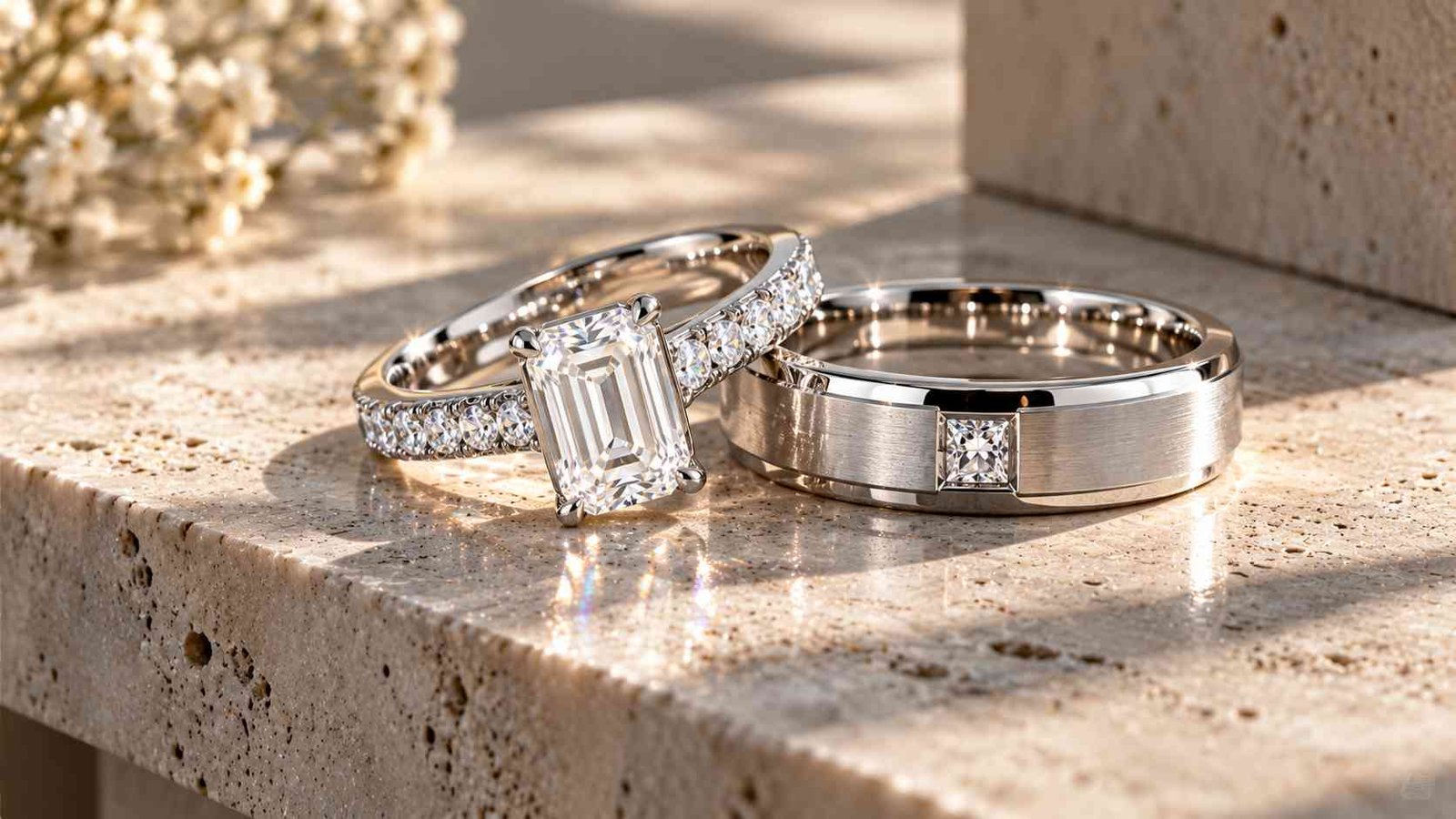
While an engagement ring marks the exciting promise of a future together, the wedding ring embodies the actual vows exchanged at the altar—a permanent, daily companion intended to endure decades of shared life. Because wedding rings remain on the finger through workouts, boardroom meetings, family travel, and daily routines, buyers demand a rare union of striking beauty, structural resilience, and clear ethical origins. This conscious mindset has sparked a profound migration toward cultivated fine jewellery, placing lab diamond wedding rings at the center of modern bridal design.
This widespread adoption reflects a broader cultural transformation in fine luxury. Industry reports analyzing market shifts highlight that investing in a modern lab-grown diamond ring allows couples to balance peerless optical fire with transparent origins and smart financial stewardship. From delicate eternity bands to bold architectural accents, laboratory-created wedding bands deliver timeless romance without the environmental footprint of conventional mining.
The Science of Man-Made Brilliance: Gemological Reality
To understand why cultivated gemstones have earned widespread acclaim among master goldsmiths and gemologists, one must explore their scientific foundation. A laboratory-created diamond is not a simulant, substitute, or cubic imitation; scientifically, chemically, physically, and optically, it is an authentic diamond in every sense of the term.
Natural geological diamonds are composed entirely of pure carbon atoms organized in an isometric-hexoctahedral crystal lattice. This specific molecular arrangement provides the gemstone’s renowned hardness of 10 on the Mohs scale, its high refractive index of 2.417, and its dispersion fire rating of 0.044. Modern technology replicates these subterranean conditions using two sophisticated scientific methods:
- Chemical Vapor Deposition (CVD): A precision diamond seed plate is mounted inside a specialized vacuum chamber filled with hydrocarbon gases, including methane and hydrogen. When energized by microwave plasma torches, the molecular gas bonds break apart, allowing pure carbon atoms to rain down onto the substrate, crystallizing atom by atom into an ultra-pure gem-quality rough diamond.
- High Pressure High Temperature (HPHT): Utilizing heavy hydraulic presses that exert mechanical pressures exceeding 55,000 atmospheres and temperatures above 1,500 degrees Celsius, pure graphite dissolves in a molten catalytic alloy and precipitates onto a microscopic diamond seed, mimicking subterranean crystallization within a clean, controlled setting.
Once grown, the rough crystals are cut, shaped, and polished using the exact diamond-tipped wheels and bench methods used for centuries. Renowned independent laboratories—such as the International Gemological Institute (IGI) and the Gemological Institute of America (GIA)—evaluate lab-created stones under the rigorous 4Cs (Cut, Clarity, Color, and Carat weight), issuing verifiable certificates with microscopic laser inscriptions on the stone’s girdle.

Comparative Breakdown: Lab-Grown vs. Mined Wedding Bands
To help couples evaluate their options with objective clarity, the comparative breakdown below highlights key structural, ethical, and practical differences between modern cultivated diamonds and historically mined alternatives:
| Comparative Parameter | Laboratory-Created Diamonds | Traditional Subterranean Diamonds | Diamond Simulants (e.g., Cubic Zirconia) |
|---|---|---|---|
| Chemical Composition | 100% Pure Carbon (C) | 100% Pure Carbon (C) | Zirconium Dioxide (ZrO2) |
| Hardness (Mohs Scale) | 10.0 (Unalterable Durability) | 10.0 (Unalterable Durability) | 8.0 – 8.5 (Prone to Abrasions) |
| Refractive Index | 2.417 (Authentic Diamond Fire) | 2.417 (Authentic Diamond Fire) | 2.15 – 2.18 (Lower Scintillation) |
| Optical Dispersion | 0.044 (Crisp White & Prismatic Light) | 0.044 (Crisp White & Prismatic Light) | 0.060 (Unnatural Rainbow Flare) |
| Ecological Displacement | Contained Laboratory Cleanrooms | Substantial Open-Pit Earth Removal | Low Industrial Footprint |
| Supply Chain Provenance | Fully Documented from Seed to Ring | Frequently Fragmented Across Multiple Nations | Mass Commercial Production |
| Daily Wear & Heirloom Life | Permanent Brilliance (Lifelong Heirloom) | Permanent Brilliance (Lifelong Heirloom) | Clouds, Scratches, and Fades Over Time |
The Environmental and Human Advantages of Lab-Grown Bands
The core philosophy driving the lab-grown movement is unequivocal accountability. Traditional extraction methods move hundreds of metric tonnes of rock, mineral ore, and topsoil for every single gem-quality carat retrieved, disrupting delicate ecosystems, consuming substantial water reserves, and leaving deep industrial scars on the Earth’s surface.
In contrast, cultivated gemstones are created in clean, contained technological laboratories. As these facilities increasingly tap into clean, renewable power grids—including wind, solar, and regional hydroelectric resources—the carbon footprint of cultivated gems continues to drop. Couples receive a wedding ring with a clear conscience, knowing its creation caused zero habitat disruption, marine silt runoff, or ecosystem displacement.
From a humanitarian standpoint, lab-created diamonds eliminate supply chain ambiguity. While regulatory frameworks like the Kimberley Process have curbed conflict stones, tracing a mined diamond back to its precise mine of origin remains remarkably challenging. With lab-created diamonds, complete provenance is guaranteed from the moment the crystal seed begins to grow, providing absolute peace of mind for conscientious couples.
Top Design Styles for Contemporary Wedding Bands
Because lab-created diamonds provide exceptional value per carat, couples have the freedom to select intricate, higher-carat band designs without exceeding their wedding budgets. Here are four popular design styles shaping modern bridal sets:
1. The Full & Half Eternity Band
A classic symbol of unending commitment, eternity bands feature a continuous row of sparkling diamonds encircling the finger. While full eternity bands offer continuous 360-degree fire, half or three-quarter eternity designs are also popular choices. They position stones across the visible face of the ring while leaving a solid metal base at the palm, allowing for comfortable everyday wear and future size adjustments.
2. Contour and Curved Bands
As modern engagement rings favor low-profile baskets, fancy elongated shapes, and wide halo silhouettes, standard straight wedding bands often leave a noticeable gap when stacked. Curved, chevron, and contoured wedding bands are custom-curved to cradle the contours of the engagement ring, creating a seamless, integrated bridal stack that sits flush and comfortably against the hand.
3. Channel and Bezel-Set Wedding Bands
For active individuals who work with their hands, travel frequently, or lead athletic lifestyles, exposed micro-prongs can occasionally catch on knitwear or sporting gear. Bezel-set and channel-set diamond bands seat each stone flush within protective rims or recessed tracks of platinum or gold. This clean, geometric look protects the diamonds’ edges from accidental knocks while delivering a sleek, modern architectural aesthetic.
4. Mixed-Metal and Textured Stacks
Bridal sets are no longer restricted to matching uniform metals. Many modern brides and grooms pair an icy platinum or white gold engagement ring with a warm 18k yellow gold or romantic rose gold wedding band. Introducing hammered, brushed, or milgrain vintage borders adds visual depth and personal character to an everyday bridal stack.
A Buyer’s Blueprint: Choosing the Perfect Lab Diamond Wedding Ring
When selecting a diamond wedding band to accompany your engagement ring, following a structured gemological framework ensures lasting comfort, aesthetic harmony, and structural durability:
- Match Metal Purity and Density: Always pair metals with matching hardness ratings. If your engagement ring is crafted in 950 platinum, select a 950 platinum wedding band. Pairing a soft 18k yellow gold band directly against a dense platinum ring can cause the harder metal to wear down the softer band over years of daily friction.
- Harmonize Diamond Color Grades: If your engagement ring features an icy D, E, or F colorless diamond, ensure the accent stones in your wedding band match the same color range. Pairing near-colorless (G-H) melee diamonds directly beside an ultra-white center stone can make the band appear slightly warm by contrast.
- Prioritize Cut Precision on Melee Diamonds: Even small accent diamonds (melee) require precise cut proportions. Expertly cut micro-pavé diamonds maximize light refraction, delivering crisp, brilliant sparkle rather than dull, milky reflections.
- Demand Independent Certification: Always purchase from reputable fine jewelers who provide third-party gemological documentation from respected bodies like IGI or GIA, confirming the ethical origin, stone authenticity, and metal purity of your ring.
Conclusion: A Conscious Heirloom for a Lifetime
Your wedding ring is the ultimate lifelong companion—a daily physical reminder of vows, shared triumphs, and reciprocal support. In an era where intentional living shapes our choices, choosing an ethically produced ring carries profound meaning.
Lab-grown diamond wedding rings unite cutting-edge material engineering with time-honored artisanal goldsmithing. They offer an accessible, brilliant, and responsible path forward, proving that authentic luxury can respect both human values and our natural world. By choosing a sustainable band, you step confidently into marriage with an heirloom that will shine with beauty, pride, and purpose for generations to come.