
Introduction
Learning how to fly internationally with a dog requires more than buying an airline ticket. International pet travel involves airline policies, veterinary documents, entry rules, and suitable travel containers. Therefore, planning early can prevent stressful surprises at the airport.
Every country creates its own requirements for importing dogs. Airlines can also impose separate rules for pets traveling in the cabin or cargo hold. IATA provides international guidance for animal containers and safe air transportation. However, IATA does not replace the rules of your airline or destination country.
If you are researching how to fly internationally with a dog, start with the destination requirements. Then, confirm your airline’s pet policy before purchasing your ticket.
How to Fly Internationally with a Dog Successfully
The process usually starts several weeks before departure. Some destinations may require considerably more preparation. Requirements can include microchipping, rabies vaccination, health certificates, blood tests, parasite treatments, and import permits.
For example, EU entry rules can require microchip identification and valid rabies vaccination. Some dogs entering the EU from certain non-EU countries may also need a rabies antibody test.
Your first step should therefore be checking official government requirements. Do not rely only on general airline information. The destination country’s animal health authority determines whether your dog can legally enter.

If your itinerary includes a connection, check the transit country’s requirements too. A transit stop can create additional documentation or health requirements.
Choosing the Right Airline for Your Dog
Airlines do not all follow identical pet policies. Some accept small dogs in the passenger cabin. Others restrict cabin pets to specific routes or aircraft. Some airlines may not accept pets at all on particular international flights.
Therefore, contact the airline before finalizing your travel plans. Ask whether your dog can travel in the cabin, whether advance pet reservations are required, and whether the aircraft has specific carrier restrictions.
IATA notes that only small dogs and cats can generally travel in the cabin. Individual airlines decide whether they permit cabin pets and under what conditions.
You should also ask about the maximum combined weight of your dog and carrier. However, weight is not the only consideration. The carrier must fit the airline’s approved under-seat space.
Cabin Dimensions and Dog Carrier Requirements
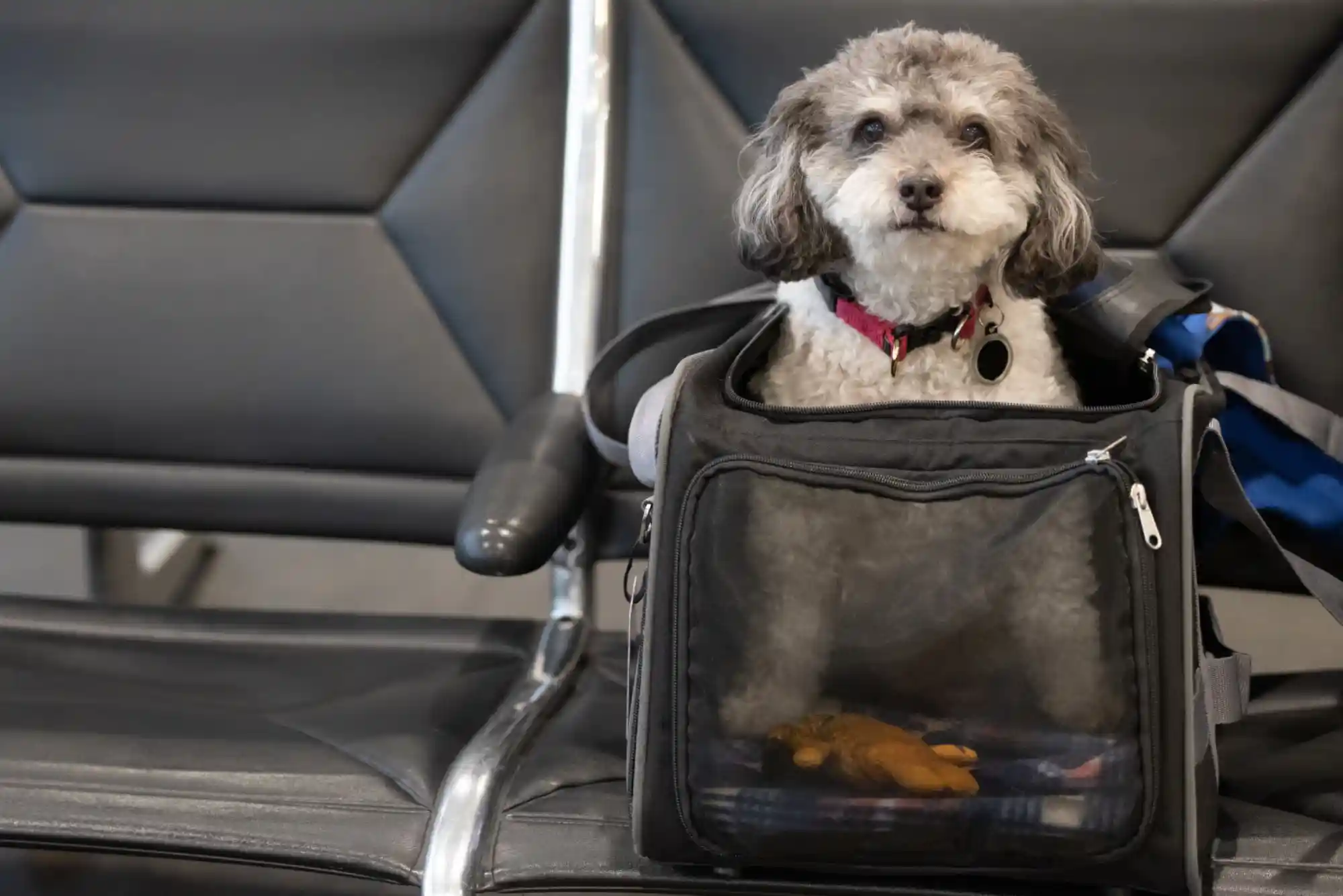
One of the most important parts of how to fly internationally with a dog is selecting the correct carrier. A carrier that works for one aircraft may not work for another.
For cabin travel, the carrier normally needs to fit beneath the seat in front of you. IATA guidance emphasizes that under-seat space is limited. Consequently, only very small dogs can comfortably meet cabin requirements.
The dog should be able to sit naturally, stand, turn around, and lie down inside the carrier. The carrier should also provide adequate ventilation and prevent escape.
IATA guidance specifies ventilation across the vertical sides of the carrier. It also requires the container to be secure and leak-resistant. Absorbent bedding should be included inside the carrier.
Soft-sided carriers are commonly used for cabin travel. However, they still need adequate ventilation after being placed beneath the seat. Excessive compression can restrict airflow and increase heat buildup.
Before booking, measure the airline’s published carrier dimensions. Then compare them with the carrier you plan to purchase.
How IATA Container Dimensions Work
IATA provides a useful method for calculating suitable container dimensions for dogs. The measurements are based on the dog’s body rather than a universal carrier size.
Measure the dog’s body length from the nose to the base of the tail. Next, measure the height from the ground to the elbow. Measure the widest part across the shoulders. Finally, measure the dog’s natural standing height from the floor to the highest point of the head or ears.
For a single dog, IATA’s guidance gives the approximate internal container length as the animal’s length plus half its elbow height. The internal width should be twice the dog’s shoulder width. The internal height should equal the dog’s standing height plus bedding.
These measurements apply to appropriate animal containers. They should not be confused with an airline’s maximum cabin carrier dimensions.
Snub-nosed breeds have additional considerations. IATA guidance indicates that these dogs require a container that is 10 percent larger under its container guidance.
Because brachycephalic dogs can have difficulty regulating body temperature, owners should discuss air travel with a veterinarian. IATA also warns against transporting snub-nosed dogs during hot weather.
Do Dogs Need a Pet Passport for International Travel?
The answer depends on your destination and country of departure. There is no single worldwide pet passport that satisfies every country’s entry requirements.
For example, the European Union uses an official European pet passport for eligible travel between EU countries. The document contains identification information, microchip details, and vaccination records.
Traveling to the EU from a non-EU country can involve an EU animal health certificate instead. The requirements depend on the country you are traveling from and the specific circumstances of your journey.
The United States provides another useful example. USDA APHIS states that the United States does not issue pet passports for international travel. Instead, dogs traveling internationally may need health certificates meeting the destination country’s requirements.
Therefore, when researching how to fly internationally with a dog, do not assume a pet passport is universally required.
Microchips and Rabies Vaccination
Identification and rabies vaccination are common requirements for international dog travel. However, the exact process differs between destinations.
EU rules, for instance, generally require a dog to be microchipped before its rabies vaccination is considered valid for travel. The first rabies vaccination normally requires a waiting period before travel.
Some countries also require rabies antibody testing. This can add substantial preparation time because the blood sample may need to be tested at an approved laboratory.
For that reason, do not wait until the week before your flight. Start checking requirements as soon as your international trip becomes realistic.
Your veterinarian can help determine which vaccinations, tests, and treatments apply to your dog’s destination.
International Health Certificates for Dogs
A health certificate is another major part of international pet travel. It confirms that your dog has met specified health requirements for the destination.
There is no universal health certificate accepted by every country. USDA APHIS explains that each country establishes its own requirements. Some destinations also require certificates to be completed within a specific period before arrival.
For travelers departing the United States, a USDA-accredited veterinarian may need to issue the certificate. Some destinations also require USDA endorsement.
The timing is particularly important. A certificate issued too early may become invalid before your dog arrives.
Keep original documents with you throughout the journey. You should also keep copies of vaccination records and other relevant paperwork.
IATA Rules for Dogs Traveling in the Cabin
IATA’s guidance is useful when preparing a dog for cabin travel. However, it is not itself an airline ticketing rule.
Your dog should remain inside the approved carrier throughout the flight. IATA guidance says passengers should not open the container or remove the animal during the flight.
The carrier should also be escape-proof and leak-proof. Absorbent bedding can help manage accidents and keep the dog more comfortable.
Introduce your dog to the carrier well before the trip. Short practice sessions can make the carrier less unfamiliar. Gradually increase the amount of time your dog spends inside it.
Food timing also deserves attention. IATA guidance suggests a light meal at least two hours before departure, along with water and exercise shortly before placing the dog in the carrier.
Should You Sedate a Dog Before Flying?
Sedating a dog before air travel should never be treated as a routine solution. IATA advises against sedation or tranquilization because these drugs can reduce an animal’s ability to respond to transportation stress.
If a veterinarian prescribes medication, follow professional instructions carefully. Inform the airline if required.
Instead of automatically relying on medication, focus on preparation. Carrier training, exercise, appropriate feeding, and a calm airport routine can help reduce unnecessary stress.
What Documents Should You Carry?
When learning how to fly internationally with a dog, organize documents before reaching the airport.
Your travel folder may include the dog’s vaccination records, microchip information, health certificate, import permit if required, rabies documentation, laboratory results, and airline pet confirmation.
Keep digital backups as well. However, do not assume electronic copies replace originals. Some destinations require original certificates or officially endorsed documents.
Your dog’s documents should match the animal’s identification details. A mismatch in microchip numbers, names, dates, or vaccination information can create problems during inspection.
Preparing Your Dog Before the Flight
Preparation should begin well before departure day. Start carrier training early, especially if your dog rarely travels in confined spaces.
Take your dog for normal walks before leaving for the airport. Allow enough time for bathroom breaks. Avoid making the airport experience unnecessarily rushed.
Check the weather for departure and arrival locations. Temperature restrictions can affect whether pets are accepted on certain flights.
Also consider your dog’s breed, age, health, temperament, and travel history. A veterinarian can help you decide whether air travel is appropriate.
What Happens at the Airport?
Arrive early enough to complete the airline’s pet check-in process. International flights can require additional document checks.
Your airline may inspect the carrier and verify your dog’s documents. Airport security procedures can also require you to handle the dog separately from the carrier.
Keep your dog secure during these procedures. A nervous dog can react unexpectedly in a busy airport.
Once aboard, follow cabin crew instructions. Keep the carrier in the required location and do not remove your dog unless airline personnel specifically instruct you otherwise.
What If Your Dog Cannot Travel in the Cabin?
Larger dogs may not qualify for cabin travel. Depending on the airline and route, alternative arrangements may include specialized animal transport or an approved cargo service.
IATA explains that cargo transportation can be an option when cabin travel is unavailable. However, the specific arrangements depend on the airline, aircraft, destination, and applicable regulations.
Do not assume every cargo hold operates under identical conditions. Ask the airline about temperature controls, handling procedures, crate requirements, and route restrictions.
Common Mistakes to Avoid
One common mistake is booking the flight before checking pet requirements. Your dog may meet the destination rules but still be rejected by the airline.
Another mistake is purchasing a carrier without measuring the dog and checking the aircraft’s under-seat dimensions.
Travelers also sometimes assume that a vaccination certificate automatically qualifies as an international health certificate. That assumption can be incorrect because destination countries establish their own requirements.
Finally, avoid leaving paperwork until the last minute. Some destinations require testing or treatments that take weeks to complete.
Frequently Asked Questions
How early should I prepare my dog for international travel?
Start as early as possible. Some destinations require multiple veterinary steps, testing, or waiting periods. USDA APHIS recommends beginning the process as soon as travel is planned.
What size dog can fly in the cabin?
There is no universal maximum dog size for cabin travel. Airlines establish their own weight and carrier limits. The dog must also fit comfortably inside an approved carrier beneath the seat.
Does my dog need a passport to fly internationally?
Not necessarily. Requirements vary by destination. Some regions use pet passports, while others require official health certificates instead.
Can I take my dog out of the carrier during the flight?
Generally, no. IATA cabin guidance states that dogs should remain inside their travel containers during the flight.
Does my dog need a microchip to travel internationally?
Many destinations require microchip identification. The exact technical and timing requirements depend on the destination. EU rules, for example, generally require the microchip before the qualifying rabies vaccination.
Can I give my dog a sedative before flying?
Medication should only be considered with veterinary guidance. IATA advises against routine sedation because tranquilizers can affect an animal’s ability to respond to transportation stress.
Conclusion
Understanding how to fly internationally with a dog makes the entire process easier to manage. Start with your destination’s official entry requirements. Then confirm your airline’s pet policy and cabin carrier dimensions.